Pen case
(Qalamdān) قَلَم دان
18th–19th century
Origin: Kashmir, North India - attribution probable
Provenance: Europe
Material: Papier-mâché, mineral and organic pigments, gold, lacquer
Design: Vishnu and the Dashavatara, with attendant and aquatic figures
This exceptionally detailed qalamdan, or traditional pen box, belongs to the refined Kar-i-Qalamdani tradition of Kashmir. The qalamdan is particularly significant in the history of Kashmiri papier-mâché: the craft was historically known by this name because pen cases were among its earliest and most characteristic objects. The surface was prepared, painted in multiple colours, embellished with gold and finally protected with layers of lacquer.
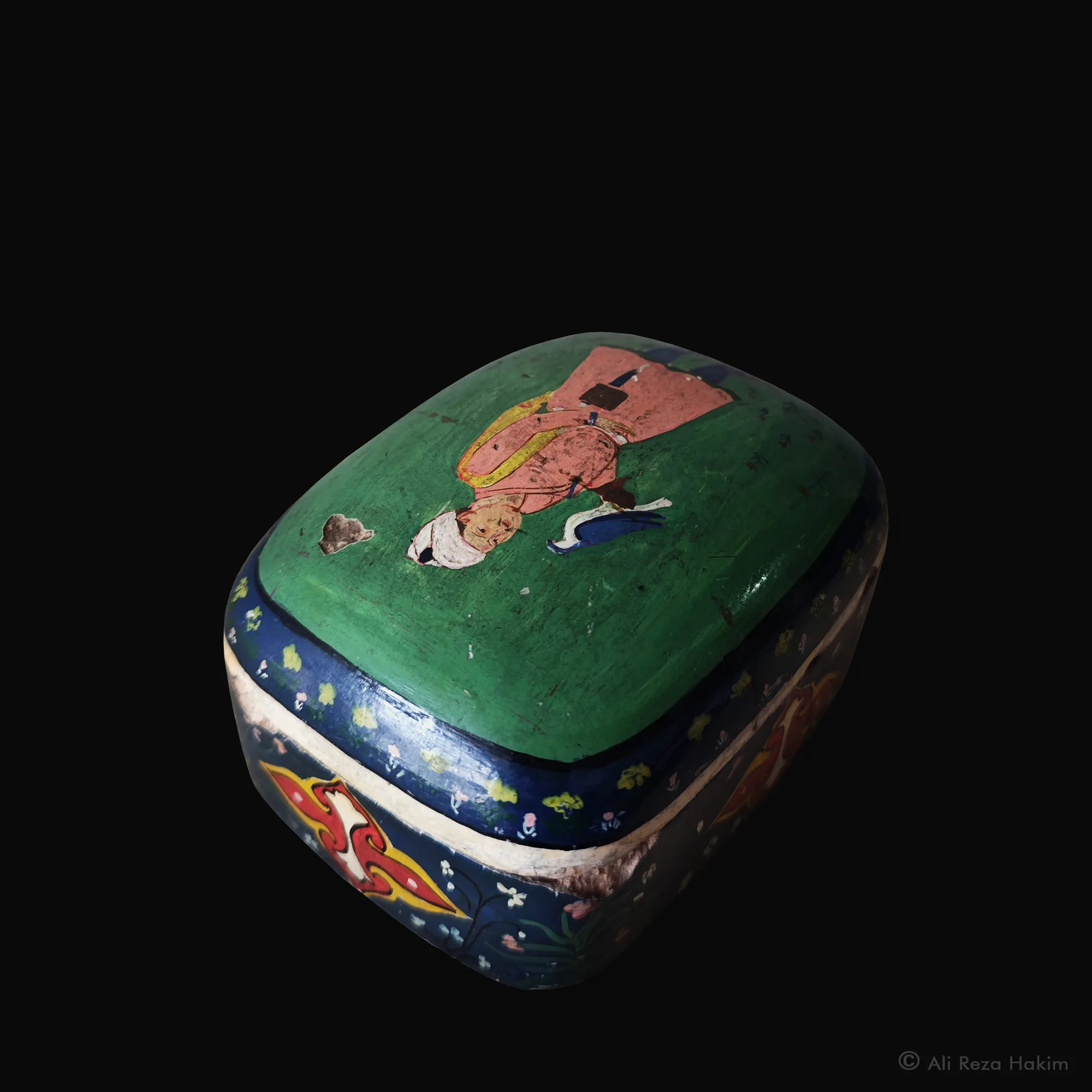
What distinguishes this example is its unusually elaborate Hindu religious imagery. Rather than the predominantly floral vocabulary for which Kashmiri papier-mâché is now known, the box is conceived almost as a continuous miniature painting. The dark bottle-green ground carries finely painted figures, animals, flowers and ornamental details in red, ochre, green and gold, arranged within narrow architectural borders.
The lid forms the principal devotional image, with Vishnu occupying the centre and surrounded by attendants. One of the long sides presents a sequence of Vishnu's Dashavatara — his ten principal incarnations. Although individual figures are now worn and difficult to identify with certainty, the repeated arrangement of distinct divine figures suggests a deliberate narrative rather than merely ornamental decoration. The shorter ends continue the Vishnu imagery, one shows Vishnu accompanied by a secondary figure, while the other includes Vishnu with two unusual aquatic, mermaid-like figures (Jalpari). Their precise identity and significance remain uncertain, but their inclusion suggests that the imagery may draw upon a particular regional or devotional narrative rather than a standard decorative repertoire.
The remaining long side is more enigmatic. Its procession of figures appears to move away from the formal presentation of the deity towards scenes of ordinary human activity, musicians, attendants and courtly or festive life. Rather than treating this simply as decoration, the arrangement may be understood as placing Vishnu's divine presence within the wider world of human existence. The distinction is necessarily interpretive, however, as the worn surface makes a precise reading of the individual scenes difficult.
The use of real gold is particularly important. Historical accounts of Kashmiri papier-mâché describe the use of high-quality gold, including gold leaf worked into a paint-like medium, while later production increasingly substituted synthetic gold paint. The surviving metallic traces on this box therefore contribute to its character as an older and particularly luxurious example of the craft.
The Hindu subject matter makes the object especially intriguing in a Kashmiri context. Anthropomorphic and religious figural imagery is far less common in the standard modern vocabulary of Kashmiri papier-mâché, which is dominated by flowers, foliage, birds and other vegetal motifs. Yet historical and comparative evidence shows that Hindu subjects did occur. A close comparison is documented Kashmiri papier-mâché object depicting Anantasayin Vishnu, demonstrating that Vishnu imagery was indeed present within the wider Kashmir-associated decorative tradition.
This raises the possibility that the present qalamdan may have been a special commission for a Hindu patron, perhaps produced by a Kashmiri naqqash working from an established religious painting tradition or manuscript source. That remains a hypothesis rather than a proven provenance, but it would help explain the unusual combination of a distinctly Kashmiri qalamdan tradition with an extensive Vishnu-centered programme. Research into Kashmiri papier-mâché has also identified previously overlooked examples of Hindu deities and scenes apparently derived from Hindu manuscripts, supporting the possibility of a broader, and now largely forgotten figurative tradition.
Attribution
Kashmir is a strong candidate for its place of manufacture. The qalamdan form itself is deeply associated with the Kashmiri Kar-i-Qalamdani tradition, while the construction, lacquered surface, fine brushwork, gilding and overall decorative method are consistent with Kashmiri papier-mâché. The presence of Hindu imagery does not, by itself, exclude Kashmir; indeed, comparative objects demonstrate that such imagery existed within the broader Kashmir-associated tradition.
Private collection: Trām and Beyond