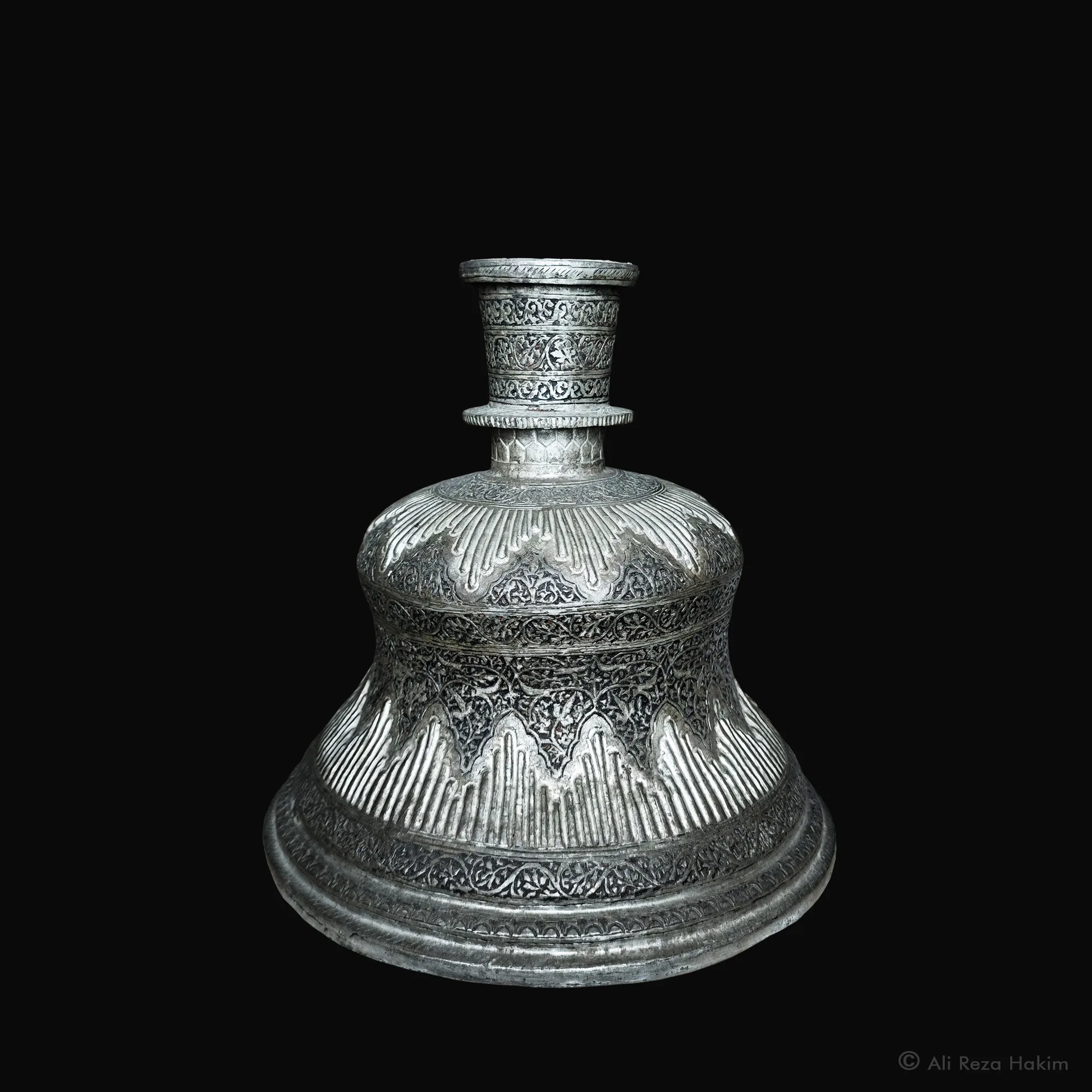
Hookah Base
(Khoj-e-Jajeer) خوجِ جَجیر
Late 19th–early 20th century Origin: Kashmir Material: Copper with tin plating and black enamel Design: Tsochal-e-Posh and Panj Haar This imposing Kashmiri copper Hookah base represents an elaborate and prestigious form of the traditional Kashmiri hookah. It would be connected to the tobacco head through a wooden stem or pipe. Its traditionally described as a Khoj-e-Jajeer, literally translated as a Jajeer of the nobleman or man of distinction. Its unusual inverted bell-like silhouette immediately distinguishes it from the modest bulbous domestic hookah. The surface is organised into alternating zones of relief and engraved ornament. Dense vegetal arabesques called “Tsochal-e-Posh” occupy the principal horizontal bands, while the shoulder is animated by radiating ribs called "Panj Haar” that emphasise the swelling form of the vessel. The contrast between these layered garlands and the finely incised coriander foliage gives the copper a particularly rich tactile quality. While both these motifs echo across Kashmiri crafts, their names and meanings are transmitted orally among artisans and collectors, rarely documented in published sources. The Jajeer was deeply embedded in everyday Kashmiri social life, traditionally shared among family members, neighbours and guests. The distinction between an ordinary Jajeer and a Khoj-e-Jajeer is particularly revealing of the social role of the Kashmiri hookah. A more elaborate Khoj-e-Jajeer, would signal higher status making it an object intended not merely as a smoking implement but also as a conspicuous domestic possession. Private collection: Trām and Beyond
Not for Sale
Enquire About This Item
Enquiring about: Hookah Base