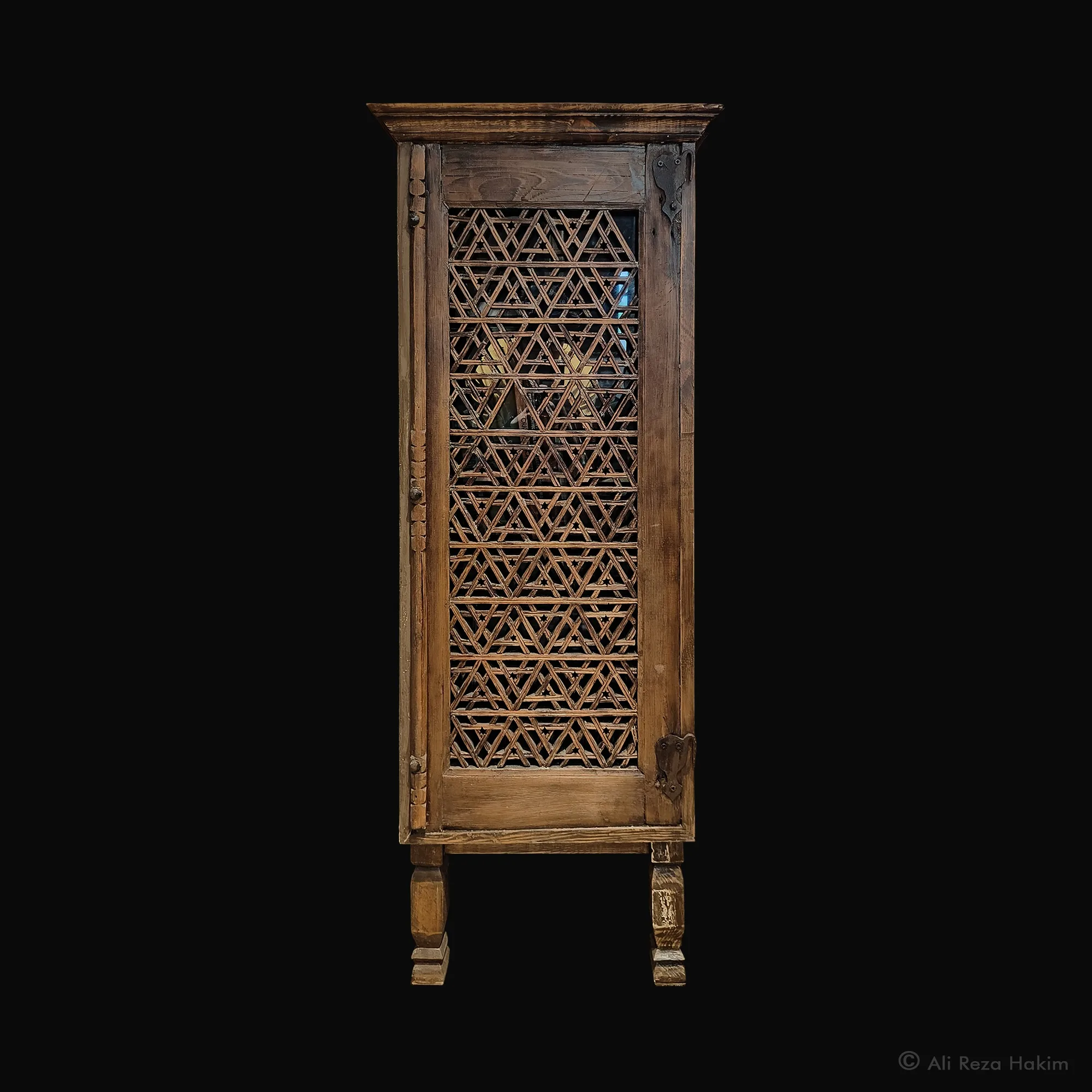
Pinjrakari Cabinet
Designed around a nineteenth-century Kashmiri window, distinguished by its intricate geometric Pinjrakari latticework, this cabinet is an example of adaptive reuse in which an architectural fragment has been given a new life as furniture. Pinjrakari, is one of Kashmir's characteristic traditions of wooden latticework consisting of precisely cut wooden laths arranged into interlocking geometric patterns. Rather than allowing the historic window to remain a fragment of a vanished building, it has been carefully cleaned, conserved and finished before being incorporated as the principal element of a storage cabinet. Here, the original architectural function has been transformed without erasing the identity of the historic element. The aged timber, irregularities and traces of use in the window are retained, while the surrounding cabinet has been constructed to accommodate it providing a practical contemporary function for storage. The result is not a reproduction of an old Kashmiri piece, but a new object whose character derives from the survival of an original architectural component.